
Third ion source at MedAustron: Helium expands the research spectrum
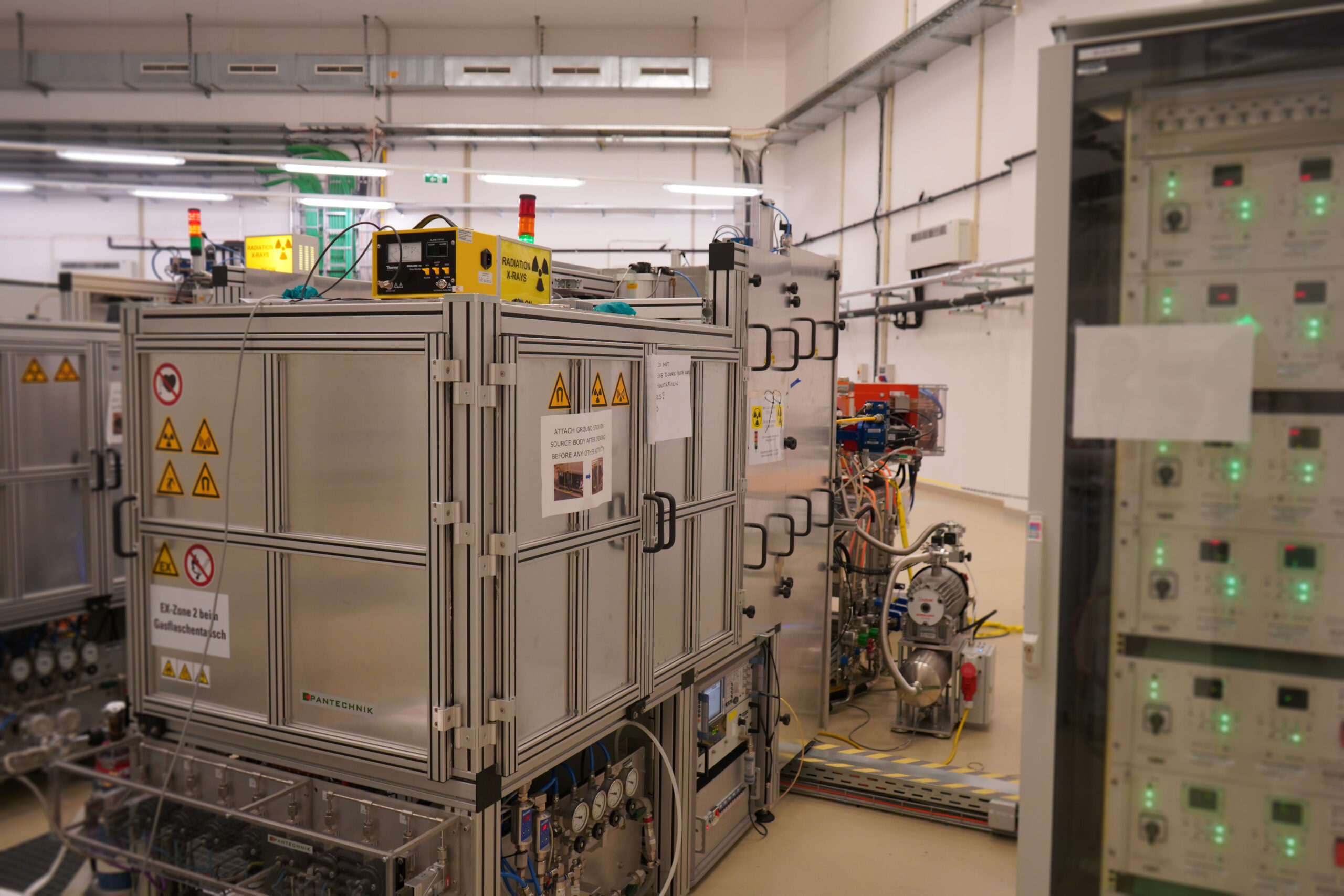
Since last year, the cancer research and treatment center MedAustron has had a third type of ion at its disposal: helium. In addition to protons and carbon ions, helium ions can be generated in a dedicated ion source and accelerated to high energies using the existing accelerator structures, after which they are used for research purposes. This expands MedAustron’s portfolio of particle types and opens up new perspectives in non-clinical research.
Helium consists of two protons and two neutrons and is the second lightest element in the periodic table after hydrogen. It is therefore four times heavier than protons but has only one third of the mass of carbon. In MedAustron’s particle accelerator, helium ions can be accelerated to the same velocity as carbon ions, meaning up to 200,000 kilometers per second—around two thirds of the speed of light.
Helium ions in the focus of research
In addition to the already established protons and carbon ions, helium ions offer additional opportunities for research projects in medical radiation physics, such as the development of dedicated detectors and dosimeters for this particle type, new algorithms for treatment planning, or innovative approaches in imaging.
International data on the use of helium ions in cancer therapy are currently still limited. This makes the preclinical research at MedAustron all the more significant, as it investigates how helium could be used for targeted tumor irradiation. Initial studies can provide important empirical data that are indispensable for any future clinical application of helium at the MedAustron accelerator. Potentially, helium offers advantages over both protons and carbon ions: due to its fourfold higher mass compared to protons, lateral scattering is reduced, which could allow for even better sparing of the surrounding healthy tissue.
At the same time, helium—like carbon—is expected to be particularly effective in radiotherapy, as strong biological effects can be achieved with lower doses. Carbon ions can fragment within the body; the resulting fragments have different ranges and may reduce the precision of the treatment. Helium ions, by contrast, are especially stable: due to their high binding energy, the probability of fragmentation is significantly lower. This can enable even more precise irradiation and an increased radiation dose within the tumor, while further reducing side effects. Helium thus represents an additional building block that can be used in combination with different particle types in therapy to selectively exploit the advantages of each.
A combined beam of helium and carbon ions
A particularly innovative project, established as a collaboration between TU Wien, the Austrian Academy of Sciences, and MedAustron’s Innovation and Development Department, investigates the generation and acceleration of a combined beam of carbon and helium ions. In the so-called sequential injection process, helium ions are first injected into the particle accelerator, followed by carbon ions. Both particle types are then accelerated together and formed into a single beam. MedAustron is the first clinical accelerator worldwide in which this type of beam generation has been successfully achieved.
But what can a combined beam be used for? Doctoral student Matthias Kausel, who was involved in the development of the injection scheme, explains: “As the human body is constantly subject to slight changes due to breathing or organ motion, small deviations can occur during irradiation, which can be detected using the combined beam. Since helium ions have approximately three times the range of carbon ions, the residual energy of the helium ions can be measured after they have passed through the body. This residual energy provides information about the patient’s anatomy and positioning. In the future, the combined beam could therefore represent a potential tool for simultaneous treatment and verification of patient positioning.”
To what extent helium can be established in routine clinical practice at MedAustron remains the subject of future research and development. With these new possibilities, MedAustron—together with other leading centers—is actively helping to shape this innovative path.